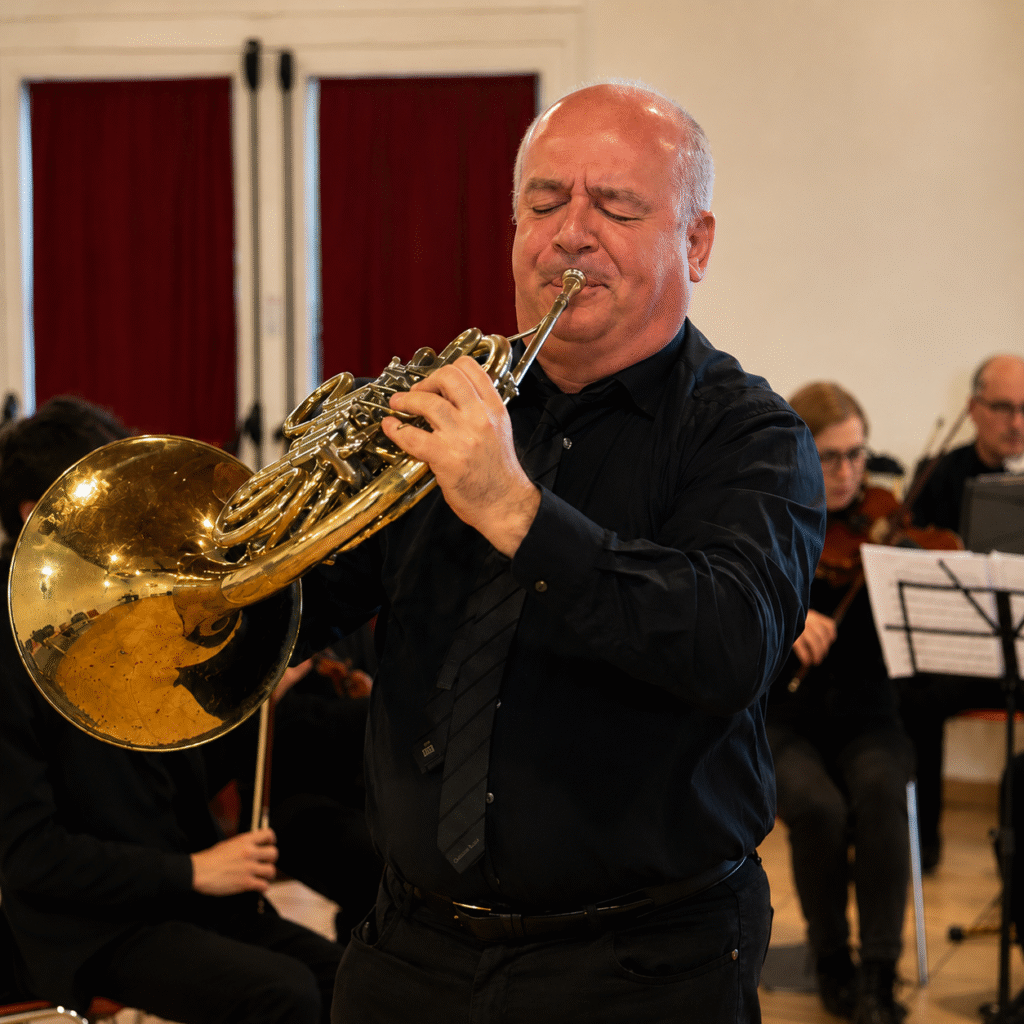
A profile of the Italian horn soloist and artistic director
He was ten years old when he first picked up the French horn in a small town in the Italian Alps. Today, Alberto Cappiello is a name recognised on concert stages from Seoul to Mexico City.
A Childhood Shaped by Sound
Alberto Cappiello was born on 25 June 1969 in Cles, in the Trentino province of northern Italy, and grew up surrounded by the orchestral and brass traditions of the region. He began lessons at the age of ten, studying in Rimini and then at the historic Conservatorio “G. Rossini” in Pesaro, where he earned his diploma with the highest marks in 1988. That same year he was admitted to the Orchestra Giovanile Italiana, the national youth orchestra that has long served as a gateway to Italy’s professional musical life.
Forging a Voice Between Two Traditions
Cappiello’s artistry was shaped on both sides of the Alps. After his Italian diploma he travelled to Budapest on a scholarship, absorbing the Central European brass school within the Franz Liszt Academy tradition. He then enrolled at the Hochschule für Musik Carl Maria von Weber in Dresden, one of the leading conservatories of the German-speaking world, where in 1996 he was awarded the special soloist diploma with top marks – the highest performance qualification a German conservatory offers.
The result, as Italian critics have observed, is a sound that fuses German-school power and precision with the warmth of the Italian operatic and chamber tradition he first learned in Pesaro. A Special Prize at the 1993 Philip Farkas International Horn Competition in Budapest, and finalist placings at two further international competitions in London and Copenhagen in 2010, confirmed his standing.
The Leap to a Solo Life
For years Cappiello played within Italy’s most storied ensembles – the orchestra of Teatro alla Scala in Milan, the Teatro di San Carlo in Naples, the RAI National Symphony Orchestra, the Turin Philharmonic, and the Lugano Radio Orchestra – and appeared in the Sanremo Festival orchestra in 2010 and 2013, before millions of television viewers. Then, in 2014, he made a decisive choice: to devote himself fully to the solo concerto repertoire he loved, above all the works of Richard Strauss and Reinhold Glière.
Received as a Star
The gamble paid off. As a soloist he has appeared with the Rotterdam Wind Ensemble, the Korea Symphony Orchestra, the National Chamber Orchestra of Armenia, the Mussorgsky Symphony Orchestra, the Milano and Arezzo Chamber Orchestras, the Cuban National Symphony Orchestra, and the Metropolitan Philharmonic Orchestra of Mexico City, among many others, alongside frequent recitals in duo with piano. On 15 November 2023 he performed Strauss’s Horn Concerto No. 1 with the Korea Symphony Orchestra in Seoul; his Korean appearances were, in the words of the Italian press, received “as a star.” Since 2017 he has also led the Rimini Chamber Orchestra as artistic director and principal horn.
Beyond the Concerto Stage
He also completed the Italian secondary-school programme of Maturità scientifica during his school years. With the Rimini Chamber Orchestra, which he has led as artistic director and principal horn since 2017, he premiered Glière’s Horn Concerto in a new chamber arrangement for horn and strings in a concert at Coriano near Rimini, and has performed Telemann’s Horn Concerto with the ensemble. Away from the concerto stage he gives horn-and-piano recitals with the pianist Ulysse Bonaventura.
On Record
His catalogue continues to grow. Cappiello’s recordings – his debut album The Weber Concertos, the Richard Strauss Horn Concertos, the Bach Suites, and the Forster Horn Concerto – are available on Spotify, Deezer, Apple Music, YouTube, and YouTube Music, alongside an earlier studio recording of Strauss’s Horn Concerto No. 2 made in the Republic of San Marino. For a musician who began in an Alpine town far from the great concert halls, it is a remarkable arc – and, by his own account, one still being written.